Analysis
From Reaction to Strategy: Making Proscription of Far-Right Organisations an Effective Tool of Democratic Defence
16 Jun 2026
Proscription of Far-Right Organisations Around Europe
Governments across Europe have directed increasing attention to threats posed by far-right organisations in recent years. For example, in April 2024, the British government banned the Terrorgram Collective, an online network promoting right-wing terrorism. In May 2025, the German government banned Königreich Deutschland, a sovereign citizen organisation that rejects state authority. And in June 2025, the French government banned Lyon Populaire, a small extreme nationalist group.
Proscription, declaring an organisation unlawful and criminalising its further activity, is a severe but not uncommon measure used by states to curb extremist threats. However, while proscription has been an effective tool, extremist groups have a greater capacity than ever to evade the enforcement of proscription, especially by moving their operations online or abroad. To ensure that proscription remains a potent tool of democratic defence against extremism, states must shift from reactive approaches to a more strategic use of proscription. This means rigorously assessing how applying proscription will (or not) disrupt extremist activity. States must also intensify transnational cooperation against far-right groups to limit the possibilities—exploited by many active far-right groups—to play the jurisdiction game, dodging more restrictive national contexts by relocating some of their activity to a different country.
This article examines recent uses of proscription against far-right groups, how proscription decisions have been made, and what effects those decisions have. Together, this analysis suggests that states should consider the wider impacts of using proscription so that proscribing an organisation not only addresses unlawful activity but also contributes to curbing extremism more generally.
Proscription Patterns
Many European states have long histories of confronting domestic political extremism, namely individual or group political activity within a country that is essentially antagonistic to democratic processes or liberal constitutional principles. Responses to such extremism often come in the form of democratic defence measures, that is, actions directed against specific individuals or groups limiting their freedoms, rights, or capacities. Among the most severe of such measures is proscription (also referred to as banning, listing, designating, blacklisting, exclusion, and outlawing), which means declaring an association or group unlawful and criminalising its further operation.
Historically, several waves of institutional development have created extensive arrays of democratic defence measures across Europe. Some states had (and used effectively) laws enabling proscription in the interwar era. Post-war regimes in Germany, Austria, Italy, and Romania all instituted measures specifically against fascist or National Socialist activity—though interpretation and application of these measures differ significantly, for example, in Germany and Italy. As democratisation swept through the Eastern Bloc in the 1990s, Hungary, Latvia, Lithuania, and Poland created measures to combat the promotion of any totalitarian regime (whether fascist, Nazi, or communist). And following the terrorist attacks in 2001 and afterwards, governments throughout Europe passed new counter-terrorism provisions that are sometimes applicable to domestic political extremism.
Typically, proscription addresses the illegality of a particular group but is also intended more broadly to deter the threats posed by extremist activity. This is evident in how state actors communicate proscription orders. For example, when the German government announced in January 2020 the proscription of the far-right group Combat 18 Deutschland, it stated that “today’s ban is a clear message: right-wing extremism and antisemitism have no place in our society.” A specific organisation is banned, but a chilling effect on the wider extremist scene is also intended. Building on a study in 2021 of proscription practices, my colleagues and I recently completed a project (‘European Violent Right-Wing Extremism Monitoring [EVREM] Project’) that relied on teams of country experts to identify proscription cases in Europe.
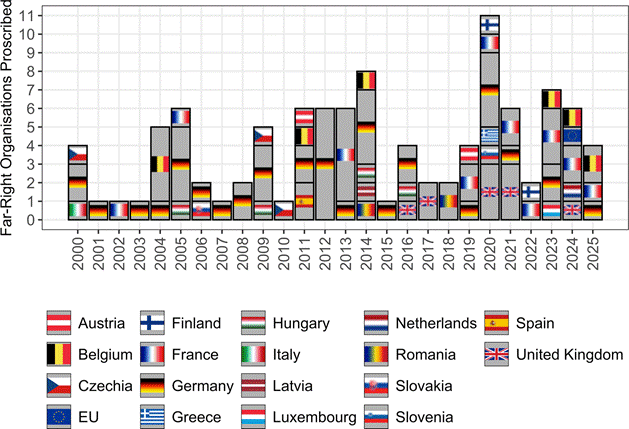
Seventeen European countries (including the UK) have proscribed at least one far-right organisation since 2000 (and one proscription by the EU, when it designated The Base a terrorist entity in 2024). France and Germany account for the lion’s share of proscriptive action. For both, it is a product of having large contingents of far-right activists, as well as long histories of democratic defence against far-right activity. Yet, even without the cases from these two prominent countries, several organisations around Europe have been proscribed. Figure 1 shows that more countries have proscribed far-right organisations in the last five years than at any other period since 2000. These proscriptions have targeted highly localised organisations like Lyon Populaire in France, loosely organised and widespread groups like Königreich Deutschland in Germany, transnationally networked organisations like the Hammerskins, and groups like The Base and Terrorgram that are active almost exclusively online. In other words, states are using proscription to address a diverse array of organised far-right activity.
Depending on the country, proscription against far-right groups in Europe can result from a decision of the government or from a judicial body—with the former configuration accounting for fewer states but many more proscribed organisations. This discrepancy is the first hint that proscription is about more than extremist organisations’ illegality: as discussed in the next section, ministries are more responsive than the judiciary to popular calls for action and other forms of social pressure.
Typically, proscribed far-right organisations have been small, espousing racially discriminatory or neo-Nazi ideology, and actively engaged in or at least vocally supportive of violence. The latter two characteristics are frequently cited justifications for proscribing organisations. In Germany, for instance, the 2020 proscription of Combat 18 Deutschland cited chiefly the organisation’s neo-Nazi ideology. Proscriptions of the Nordic Resistance Movement (Finland, 2020), The Base (Netherlands, 2024), and Terrorgram (UK, 2024) referred to acts of violence, violent intent, and promotion of violence.
Dealing with far-right ideologies and violence is no new task for European states. However, among the many patterns and trends in recent proscription cases, states now must contend with groups that organise primarily (sometimes exclusively) online, that are keenly aware of proscription and adapt to mitigate potential consequences, and that more than ever operate transnationally, sometimes playing the jurisdiction game: evading more restrictive national contexts by relocating some of their activity to other countries, as when German Identitarian activists moved financing activities to Poland to escape the putatively closer state security monitoring in Germany. The novel frequency of these features represents a new challenge to states’ efforts to rein in domestic political extremism.
Figure 1: Proscription of far-right organisations proscribed since 2000 in EU Member States and the United Kingdom.
Proscription Decisions
Three sets of factors influence whether an extremist organisation is targeted for proscription: historical, situational, and organisational factors. First, a country’s historical experiences or longstanding commitments can influence whether organisations are proscribed. For example, Germany has laws enabling organisational proscription that were created to protect their democracy from the sorts of movements that overthrew democratic regimes in the early twentieth century. They might refer to treaty obligations, such as the 1965 United Nations’ International Convention on the Elimination of All Forms of Racial Discrimination, which in Article 4b commits states to prohibit racist organisations. And states might also be influenced by proscriptive action taken in other countries. Together, such historical factors shape the feasibility of proscribing extremist organisations.
Second, several situational factors relating to contemporary political circumstances can influence proscription practices. The ideological posture of the sitting government plays a key role in proscription decisions. Far-right political parties often downplay the threats posed by right-wing extremism. If such actors occupy veto positions or other influential roles, they may act to prevent or delay proscription. This might help explain why, in Italy, predominantly led by right-wing governments in recent decades, only one far-right organisation (Fronte Nazionale in 2000) has been proscribed in the past 30 years, in spite of hosting a large and violent ecosystem of far-right organisations. In contrast, approval ratings or electoral considerations might lead governments to take strong actions like proscribing extremist organisations in order to shore up political support.
Third, several attributes can influence proscription decisions, besides determining whether an organisation is operating unlawfully, even if such organisational characteristics are not solely decisive. The size of an organisation’s membership, its organisational structure, the geographic extent of its activity, the ideology it espouses, its link to violence, and any connections to previously proscribed organisations are among the most consequential facets that are usually assessed against legal standards in deciding and justifying proscription.
The interplay of these three sets of factors can be detected by looking at their coincidence in specific cases. In an article investigating decades of proscription decisions in Germany—summarised in The Loop—I identify four distinct patterns of organisational factors among proscribed groups in Germany: (i) many groups that promote neo-Nazi ideology, (ii) several longstanding organisations that act as networking hubs for the wider extremist scene, (iii) a handful of exceptionally violent organisations, and (iv) a few extremist groups in the 1990s that masqueraded as political parties. That groups sort into these categories of organisational attributes is not particularly surprising, especially in Germany, where historical factors have created strong institutions to guard against neo-Nazism. However, what is striking is a conspicuous regularity in situational factors: all 31 organisations proscribed by Germany’s federal governments between 1990 and 2023 occurred in situations of high far-right visibility, either due to a specific odious group or broader outrage over a far-right incident(s) (even if unrelated to a particular organisation). This is because social pressure is often a crucial catalyst for governments and decision-makers to take action, ‘do something’ against extremist activity.
This finding reflects the fact that, though sufficient legal grounds for proscribing an organisation are needed, governments have sometimes used proscription as a means of demonstrating responsiveness. Underlying proscription decisions are complex processes involving historical, situational, and organisational factors. Germany is not unique in this. Particularly obvious instances of public pressure spurring on proscription can be seen in the cases of Unité radicale (France, 2002), National Action (UK, 2016), Golden Dawn (Greece, 2020), and Génération Identitaire (France, 2021). A member of Unité radicale tried to assassinate President Jacques Chirac in July 2002. National Action was banned after supporting and promoting the murder of British MP Jo Cox. The murder of an anti-fascist rapper in 2013 and then years of campaigning by anti-fascist NGOs led to the ban of Golden Dawn. And Génération Identitaire was proscribed in France after connections to numerous violent incidents, most notably the 2019 right-wing terrorist attack in Christchurch, New Zealand.
Proscription Effects
What are the effects of proscribing extremist organisations? The direct consequences are similar across Europe: organisations are prohibited from continuing activity, organisational assets might be seized, group symbols may be forbidden, and members or leaders may face criminal penalties. However, many extremist organisations adapt quickly in response, which undermines the efficacy of proscription measures. One common adaptation is reconstitution under a new name. Though most legal frameworks explicitly prohibit this, leading activists from proscribed organisations quite often try to carry on the same activism with many of the same members despite proscription orders. For example, following the 2020 proscription of the Nordic Resistance Movement (NRM) in Finland, former activists and sympathisers formed Kohti Vapautta (‘Towards Freedom’), but it was proscribed by court order in 2022 as a continuation of the NRM. Greece’s supreme court banned the neo-Nazi Golden Dawn party in 2020 and then ruled in 2023 that the Hellenes party, led by a prominent Golden Dawn figure, was a continuation of the banned party and thus illegal.
Another common adaptation is the fragmentation of the group into smaller, less visible cells. For example, proscribed organisations may carry on essentially the same operations (even if some members and assets have been seized) as ‘comradeships’ or informal groups that are harder to monitor. One consequence of the German government’s (ultimately failed) attempt in the early 2000s to Nationaldemokratische Partei Deutschlands (NPD, ‘National Democratic Party of Germany’) was an uptick in activity among such smaller groups.
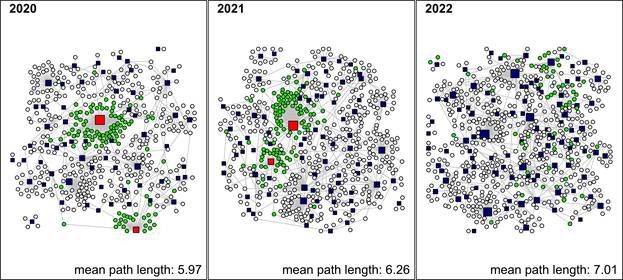
Proscription can also send a deterrent signal to individual extremist members or to other extremist entities, making them more cautious in their public activity or prompting internal debate about reorientation away from violence and illegal activities (to reduce their susceptibility to proscription). Consider a couple of recent cases in France. In March 2021, the French interior minister Gérald Darmanin proscribed Génération identitaire; and in November, the closely-related organisation L'Alvarium. Figure 2 depicts the network created by far-right organisational affiliation in France, before and after these two decisions from 2021, with inter-organisational connections resulting from individuals with multiple affiliations. It shows a clear effect of the measures on the French far-right networks, with 105 affiliates of the organisations active prior to the bans and ‘only’ 56 affiliates remaining afterwards, having migrated to other groups (a similar dropout rate to other cases). This suggests proscription does have a deterrent effect, driving individuals away from far-right activism.
Figure 2: Network of French extreme right organisations (squares) and affiliates (circles), panelled by year. The red nodes represent ’Génération identitaire’ and ’L’Alvarium’, both proscribed in 2021, and the green circles are their affiliates.
On the other hand, however, proscription can also have galvanising effects: proscribed groups are sometimes portrayed within broader extremist ecosystems as victims of state repression, which can fuel grievance narratives and increase group cohesion among sympathisers.
Strategic Proscription
Proscription is one of the most important tools of democratic defence against extremism. States have an interest in using this tool not merely for its direct effects against unlawful extremist organisations; but more broadly, as a tool to disrupt networks of extremist actors, thereby curbing extremism overall (as state actors have sometimes explicitly acknowledged).
Contemporary far-right (and other extremist) activity carries new challenges for democracies. Foremost among these are the extent of online organising, the concomitant ability to evade or overcome proscriptive measures, and the capacities to coordinate and act transnationally. Notwithstanding the disruptiveness of proscription seen in the French example above, far-right figures have adapted in hopes of mitigating its impact. Several adaptations reinforce the Whack-A-Mole problem: proscription may knock out organisations, but others emerge to take their place. State authorities across Europe have consistently played a reactive game against a decentralised and adaptable movement. To disrupt extremist ecologies effectively and consistently, states should match their consideration of direct consequences with consideration of broader, network-level consequences of what adaptations a proscription will trigger and how those affect exchange, cooperation, and cohesion among extremist scenes.
States must therefore adopt a more strategic approach to proscription, assessing the likely consequences of proscriptive action both for actors directly affected and for wider scenes of extremist activity. That means considering the individual level (the activist histories of individual extremists and the likelihood of their dropping out of activism), the organisational level (how a given group has emerged and acted and whether its core membership will likely try to persist despite proscription enforcement), and the network level (what position an organisation occupies and whether proscribing it will significantly disrupt the wider extremist milieu).
This article represents the views of the author(s) solely. ICCT is an independent foundation, and takes no institutional positions on matters of policy unless clearly stated otherwise.
Photo credit: Anton Lung/ Unsplash